
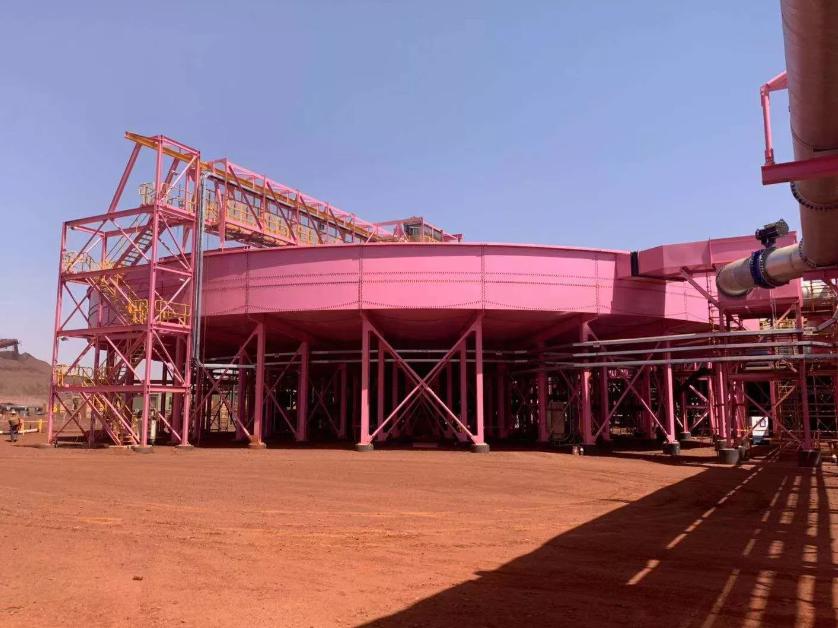
A mining thickener refers to dewatering equipment experts prefer to separate water from the solution for recycling purposes. Additionally, professionals prefer thickeners to treat wastewater, sludge, or water residue in industries.
Top Examples of Mining Thickeners in the Market Today
Below are the main kinds of thickeners that plants rely on in 2024.
Tilted plate thickeners
Miners recommend this thickener to dewater fine-grained minerals because it has a small body. The beauty of this mining thickener is that it features multiple plates that shorten the sludge’s settling time.
Deep cone thickener
Technically, this mining thickener has a conical shape and a discharge valve at the bottom to release sand and drainage. Usually, the cone angle ranges between 55 and 60 degrees to accommodate slurry with excess mud.
Generally, a deep cone thickener helps to dewater raw pulp, separating products (magnetically) and dehydrating the solution before adding the ore into the centrifuge,
Rack thickener
A functional rack thickener features an excellent transmission mechanism, tank, and a sizable rake frame to guarantee quality gravity sedimentation. Usually, this large equipment separates small particles from the liquid during mineral processing.
Unknown to many, professionals classify rack thickeners into peripheral and center transmission systems. The beauty of this thickener is that it can accommodate mineral particles with a diameter ranging between 150 and 180 meters.
Interestingly, the discussed mineral processing solutions can separate various liquids, such as water, from a thick pulp.
How a Mining Thickener Reduces Water Consumption
Research shows that using a mining thickener can help plant workers reduce water consumption by a reasonable margin. As explained, the professionals can recycle water for other uses in a mineral processing plant.
3 Impressive Advantages of Using a Modern Mining Thickener
Automates critical processes
Interestingly, a good thickener can add flocculant on its own and regulate underflow discharge to meet your requirements.
Short sedimentation distance
Secondly, it features an inclined plane that enhances sedimentation and lowers the distance. As a result, this process takes a shorter duration, speeding up the mineral processing process.
It features an adding device.
Surprisingly, a good thickener like ZJH has this component that ensures it can add flocculants based on the requirements and the equipment’s processing capacity.
Last Thoughts
People must note that the choice of a mining thickener must depend on the purpose, environment, and expected benefits. For this reason, smart miners must conduct a mineral processing test to determine which thickener type suits a particular client.